Blog · Louvered · 8 min read
Motorized Pergolas in Jacksonville: What the Motor Gets You and How They Handle Florida Weather
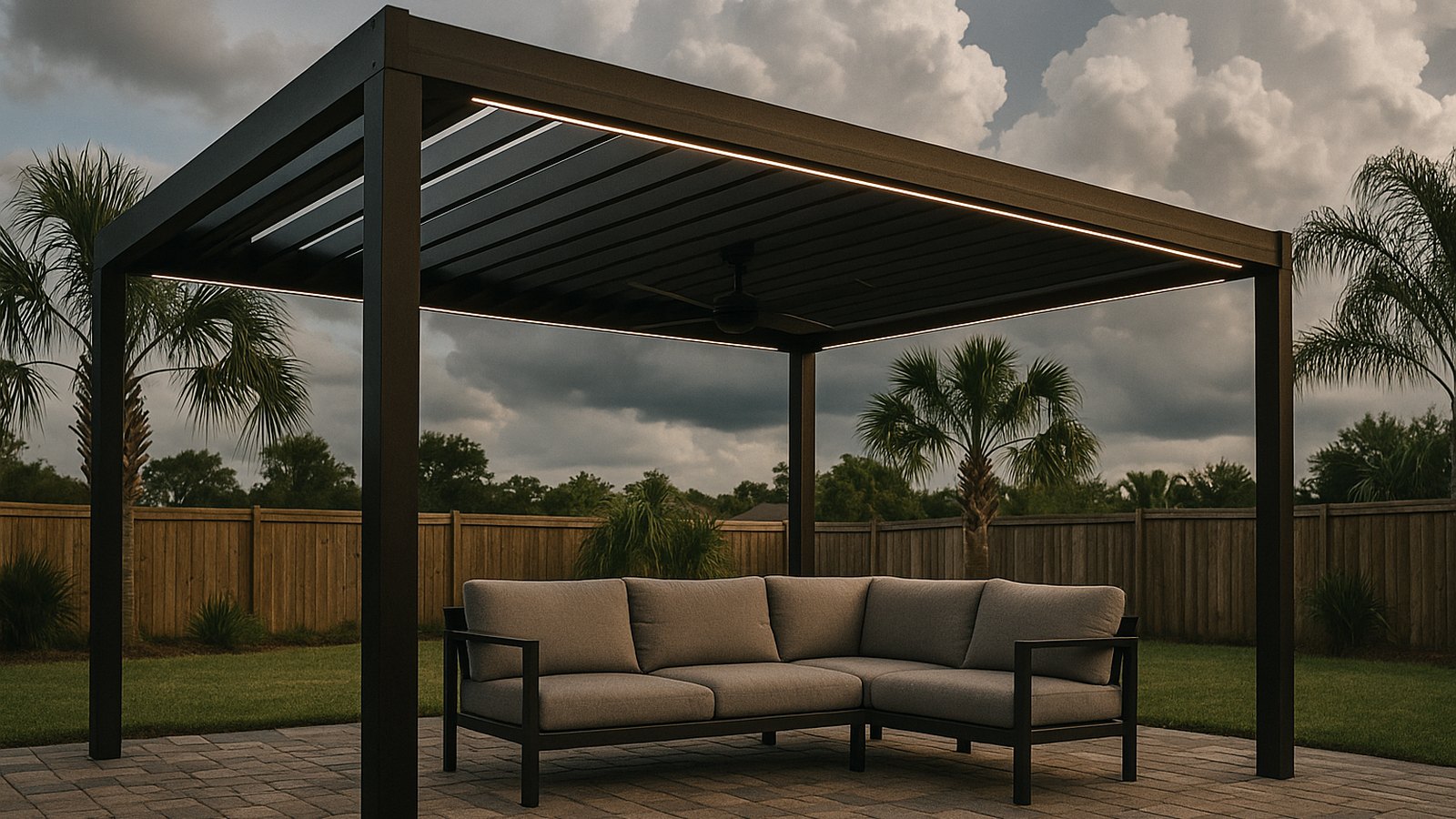
A pergola that closes its roof when the first drops of rain hit and opens it again for the evening breeze, without anyone touching a switch. That is the promise of a motorized louvered pergola, and it is the upgrade we get asked about most in Jacksonville consultations.
It is also easy to misunderstand. The motor does not make the shade any better. The louvers do that, and a manual louvered roof shades and vents exactly as well. What the motor adds is automation, and in a Florida afternoon that is worth a lot to some people and very little to others. It also adds wiring, sensors and a few responsibilities that a fixed pergola never asks of you.
The short version. A motorized pergola automates the louvers: a remote or app moves them, a rain sensor closes them when a shower starts, and a wind sensor opens them in strong gusts. That is genuinely useful if you use the space daily or leave furniture and a TV out there. It needs a dedicated power supply run to code, sensors placed where they can actually feel the weather, gutters kept clear, and a storm routine before every named storm. If the space is for occasional weekends, manual louvers deliver most of the benefit.
What “motorized” actually gets you
A louvered pergola has a roof of rotating aluminum slats. In the manual version you set them with a crank. Motorized versions rotate them at the push of a button, and the good systems do it on their own:
- Rain sensors close the louvers at the first drops, so the furniture, the cushions and the outdoor TV stay dry even when nobody is home.
- Wind sensors do the opposite. In strong gusts they open the louvers so the wind passes through, instead of letting a closed roof act like a sail.
- Remote, app and smart home control lets you set the roof from inside the house, or tie it into the same routines as your lights.
- Integrated LED lighting and ceiling fans can run through the frame, wired in during installation rather than added later.
The louvered roof itself, how it sheds water and why it suits a First Coast backyard, is covered in our louvered pergola guide. This article is about the motor and everything that comes with it.
Manual or motorized: the honest comparison
Both versions use the same roof, and both give you the same range of shade, airflow and rain cover. The difference is who moves the louvers, and when.
Motorized makes the most sense if you use the space every day, if you leave cushions, electronics or an outdoor kitchen under it, or if you are often away when the afternoon storm rolls through. In those cases the roof closing itself is the whole point.
Manual makes sense if the pergola is for weekend evenings and you are usually standing under it when you want to change it. A crank is simple, there is nothing to wire and nothing to fail, and many of our clients are perfectly happy with it. We price and design both on the same frame so you can decide with the space in front of you.
What it takes to power one
A motorized pergola needs electricity, and that has to be planned before the posts go in:
- A dedicated circuit run from your panel to the pergola, done by a licensed electrician and usually under its own electrical permit.
- Buried conduit across the yard to the pergola, routed before the patio or pavers are finished.
- Ground fault protection, because everything out there lives in the weather.
- A controller for the motor and sensors, housed where it stays dry and can be reached for service.
If you want lights, fans or heaters under the pergola, plan their circuits at the same time. Wiring a finished pergola is possible, but it is messier and it shows. Our pergola permit guide covers what Jacksonville checks on the structure itself.
How the sensors behave on a Florida afternoon
A rain sensor responds to water landing on it, so it has to sit where rain actually falls. Mounted under an eave, behind the roofline of the house or beneath an overhanging oak, it may not notice the first shower until the furniture is already wet.
The wind sensor has a set threshold. Below it, the roof does what you or the rain sensor told it. Above it, it opens to let the wind through. Florida’s summer storms often bring rain and gusts together, and a well set up system gives wind safety priority, so do not be surprised to see the louvers open in the middle of a squall. That is the system protecting the roof.
Sensors also collect pollen, salt film and the occasional wasp nest. A quick check and clean at the start of each season keeps them responding the way they should.
Storm season: what to do before a named storm
The structure’s wind rating comes from its engineering and its footings. The motor has nothing to do with it. Before a named storm, the routine is simple:
- Set the louvers to the position the manufacturer specifies for high winds, which is usually open.
- Shut off the power to the pergola at the breaker once they are set.
- Remove fabric shades, screens and curtains, which catch wind the louvers would let through.
- Clear the deck of furniture, cushions and anything else that can fly.
After the storm, check that the gutters and downspouts are clear, make sure the sensors are clean, then restore power and run the louvers through a full cycle. For how the structure itself is engineered for our winds, see our hurricane rated pergola guide.
What fails first, and the maintenance that prevents it
The aluminum frame of a well built, powder coated pergola will outlast everything attached to it. The parts that need attention are the moving and electrical ones:
- Gutters and downspouts. When the louvers close, the rain goes into the gutters. Oak pollen, leaves and needles clog them, and a clogged gutter overflows right where you are sitting. Clear them regularly.
- Sensors. A dirty or badly placed sensor is the most common reason a motorized roof does not respond.
- Pivots and seals. The louver pivots and seals wear over time and benefit from occasional cleaning.
- Salt. Near the beaches, rinsing the frame and the sensors with fresh water keeps salt from building up on the finish and the electronics.
The motor, sensors and controller are replaceable components, more like an appliance than part of the structure. Treat them that way and they are no more trouble than any other outdoor equipment.
Who it is worth it for
Motorized louvers are worth it if the space is part of daily life: morning coffee, an outdoor kitchen, a TV, a dining table that stays set. They are worth it if you travel, or work away from home, and want the roof to look after the furniture for you.
They are less compelling for occasional use, for a space you only sit in when you are already there to turn a crank, or for a yard where a fixed roof is the better answer anyway. For that choice, see our comparison of covered vs. open pergolas for Florida backyards, and aluminum vs. wood for the frame itself.
A louvered roof is a favorite over a grill. See our guide to outdoor kitchen pergolas for clearance, smoke, fans and lighting.
Frequently Asked Questions
Is a motorized louvered pergola worth it?
What happens to a motorized pergola when the power goes out?
How long do pergola motors and sensors last?
Do louvered pergolas keep the rain out?
Can a motorized pergola survive a hurricane?
See One Before You Decide
Photos do not convey the louver action, or how quietly a good system moves. We design and install manual and motorized louvered pergolas across Northeast Florida, and we will design your space both ways so you can decide with the real thing in front of you.
Planning a pergola? Let’s design yours.
Get a detailed design plan and a free estimate — built to Florida code across Duval, St. Johns, Clay & Nassau.